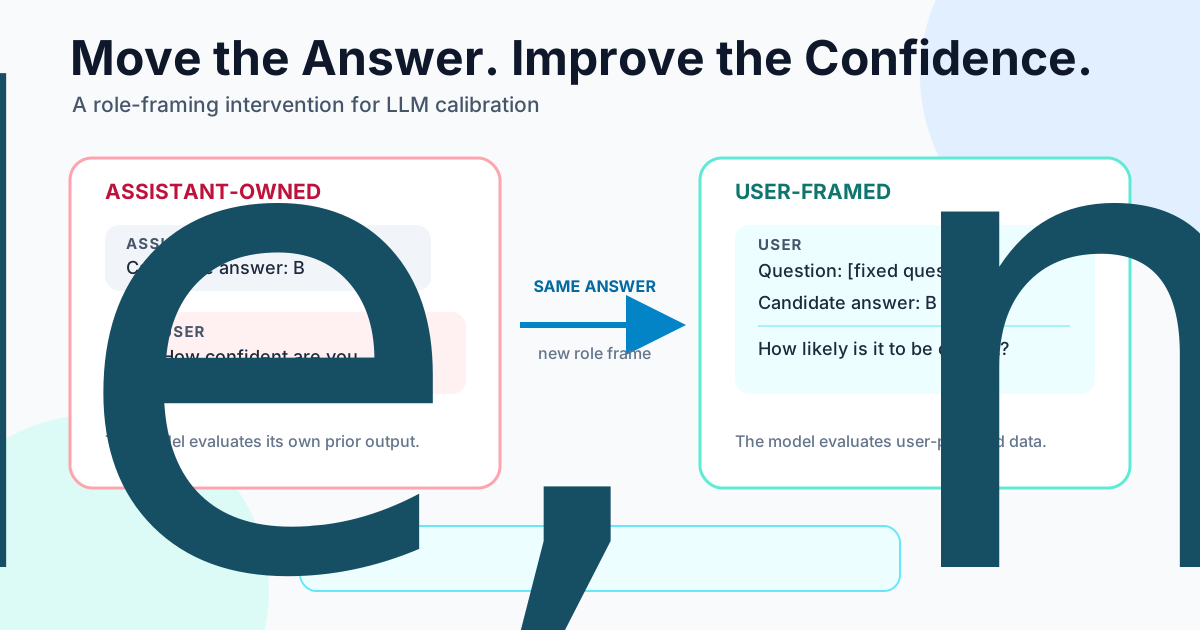
An LLM can assign less inflated confidence to an answer when the answer appears
in a user message instead of its own assistant history. The technique uses
two calls: generate the answer, then ask the model to evaluate that fixed answer
in a fresh prompt where the user supplies it as a candidate.
The content does not change. Only the message role attached to the answer changes. Sanz-Guerrero et al. found that this inference-time intervention reduced overconfidence and improved calibration across the models, confidence prompts, and objective question-answering tasks they tested. It did not require training or modify the original answer. Sanz-Guerrero et al.
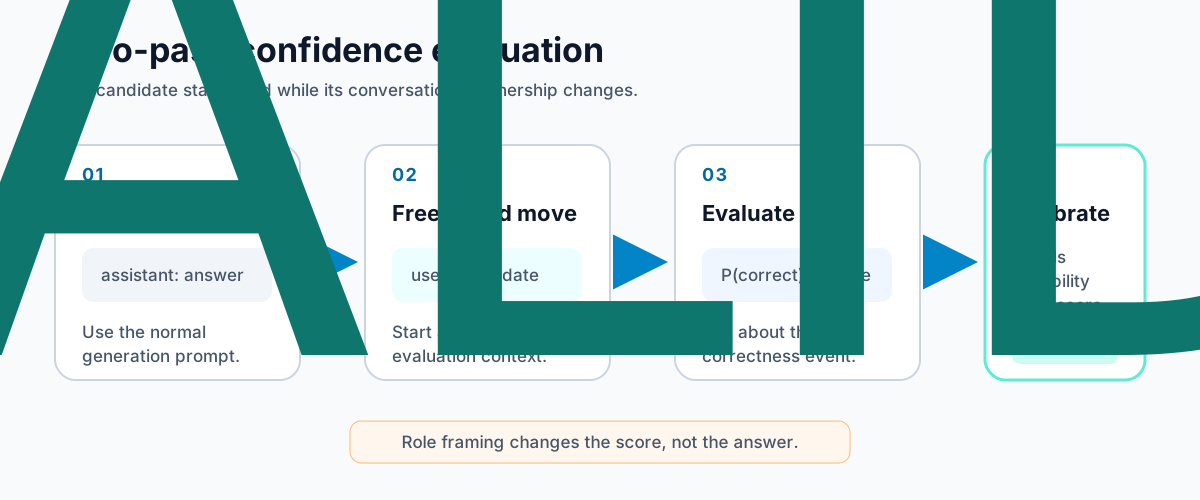
Move the answer, not the whole conversation
The standard self-evaluation prompt leaves the answer in the model’s own conversation history:
| |
The role-switched prompt starts a separate evaluation context and presents the same candidate answer as user-provided data:
| |
The numbers above are illustrative. The method does not assume that 0.64 is the right confidence for a particular example. It tests whether user-framed scores match correctness frequencies better across a labeled dataset.
For question $x$, fixed answer $a$, and correctness label $y$, the paired comparison is:
$$ c_{\text{self}}=f_\theta(x,a,\text{assistant role}), \qquad c_{\text{user}}=f_\theta(x,a,\text{user role}). $$Both scores refer to the same event, $y=1$ if $a$ is correct. Holding $a$ fixed isolates the effect of role framing on confidence. This is not a general swap of all user and assistant messages, and it should not rewrite the stored provenance of a real conversation.
Role framing changes self-evaluation
Chat templates encode user and assistant roles with different control tokens.
Instruction tuning teaches the model to continue role-conditioned
conversations, so the role attached to an answer can affect a later confidence
judgment even when the answer text is identical.
Sanz-Guerrero et al. call the observed effect ownership bias. The tested models assigned higher confidence to answers shown as their own outputs than to the same answers shown as user input, whether those answers were correct or incorrect. The authors interpret user framing as moving the model from an owner role to a more detached evaluator role. Sanz-Guerrero et al.
The observed role effect does not establish a complete causal mechanism inside the model. It is inconsistent with sycophancy as the dominant explanation for this experiment. If the model mainly deferred to the user, user-provided answers should have received higher confidence. The study found the opposite pattern.
The measured gains were large but task-dependent
The main ownership-bias experiment covered six open-weight instruction-tuned models: Llama 3.1 at 8B and 70B, Qwen3 at 4B and 30B, and Gemma 3 at 4B and 27B. Earlier work had shown that directly verbalized confidence can outperform conditional token probabilities for some instruction-tuned models, making prompt design a central part of confidence measurement. Tian et al. The ownership-bias experiment evaluated three confidence interfaces on MMLU:
- P(True): use the normalized probability assigned to
Trueafter asking whether the candidate is correct. - Verbalized percentage: ask for a number from 0% to 100%.
- Linguistic confidence: ask for a category from “very low” to “very high” and map the category to a number.
The table reports average MMLU differences across the six models. Each value is the assistant-framed result minus the user-framed result. Positive ECE and Brier gaps favor user framing; a positive raw-confidence gap means the assistant frame elicited higher confidence.
| Confidence method | ECE gap | Brier gap | Raw-confidence gap |
|---|---|---|---|
| P(True) | 9.8 points | 8.8 points | 15.8 points |
| Verbalized percentage | 17.9 points | 19.5 points | 18.1 points |
| Linguistic confidence | 26.1 points | 25.2 points | 26.8 points |
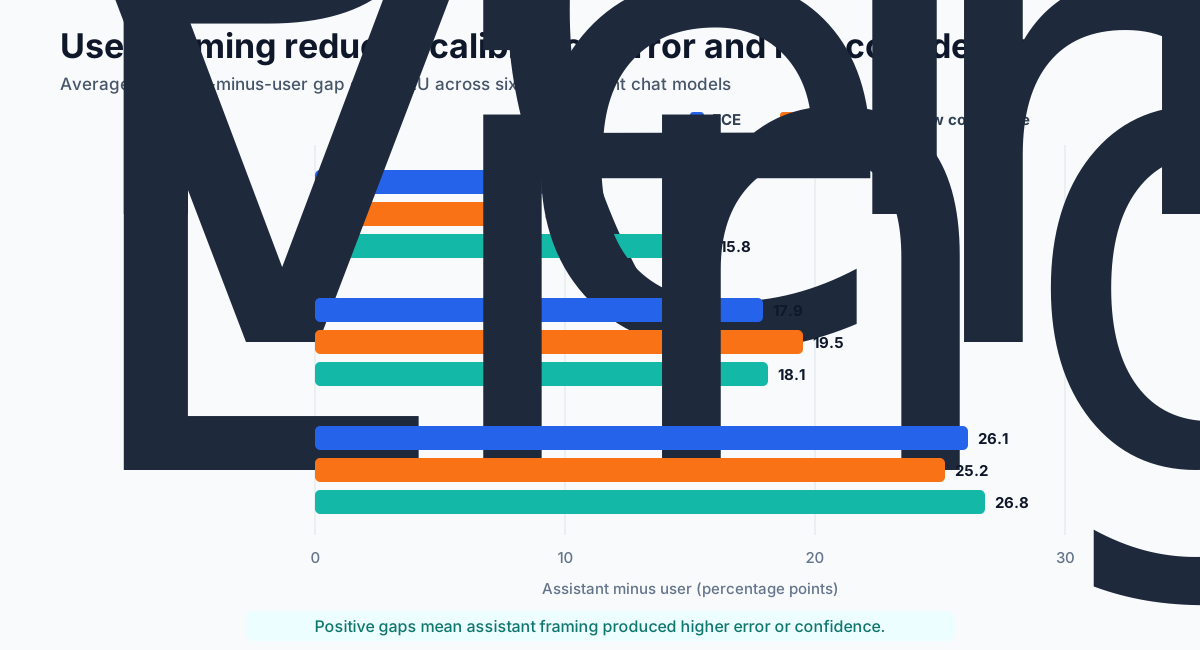
Lower expected calibration error (ECE) and Brier score are better. The user-framed prompt improved both metrics on average, and raw confidence was also lower. The paper reported the same direction on GSM8K, TruthfulQA, open-ended MMLU, and a separate GPT-5.2 experiment. The exact size varied substantially by model, task, and elicitation method. Sanz-Guerrero et al.
The study also separated post-training from chat formatting. Instruction tuning was the larger source of miscalibration in its base-versus-instruct comparisons; the chat template added further error. Moving the answer to the user message mitigated the confidence bias at inference time but did not reverse the training process that created it.
The technique improves confidence, not answers
Role switching does not change the candidate answer, so it cannot improve the candidate’s accuracy. It changes only the score used to estimate whether that answer is correct.
User framing also does not turn the new score into a universally calibrated probability. A value such as 0.70 is operationally valid only if similarly scored answers are correct about 70% of the time on representative held-out data. Evaluate both prompt variants with the same fixed candidates and labels:
$$ \Delta \operatorname{BS} =\frac{1}{N}\sum_{i=1}^{N} \left[(c_{\text{self},i}-y_i)^2-(c_{\text{user},i}-y_i)^2\right]. $$A positive $\Delta \operatorname{BS}$ means that user framing has the lower Brier score. Report a reliability diagram and ECE as well, then fit temperature, Platt, or isotonic calibration only on a separate calibration split. The model calibration guide explains those diagnostics and post-hoc methods.
Implement it as a two-pass evaluator
Use a generation call and a separate confidence call:
| |
Keep four controls fixed during evaluation:
- Use the identical candidate answer in both role conditions.
- Use a fresh evaluator context so prior assistant turns do not preserve the ownership cue.
- Keep the confidence question, model version, and decoding settings fixed.
- Treat candidate text as untrusted data so embedded instructions cannot take control of the evaluator.
For multiple-choice tasks, normalized probabilities across all options are often cleaner than independently elicited percentages. For free-form answers, define the correctness event and labeling procedure before measuring calibration.
Validate the method on the deployment distribution
The published evidence supports objective question answering. It does not yet establish the same benefit for subjective judgments, long-form responses, tool use, medical decisions, or continuously changing production traffic. The paper also focused mainly on open-weight models and tested one proprietary model. Sanz-Guerrero et al.
A production evaluation should therefore:
- collect representative questions, fixed candidate answers, and trustworthy correctness labels;
- score every candidate with both assistant-owned and user-framed prompts;
- compare Brier score, reliability diagrams, ECE, and risk-coverage;
- use paired bootstrap intervals because both prompts score the same examples;
- choose the prompt and any post-hoc calibrator on a validation split;
- report final performance once on an untouched test split;
- recheck calibration after changing the model, template, task, or traffic mix.
Prompt framing can reduce one systematic bias. It cannot detect consistent falsehoods, repair weak labels, or protect against distribution shift.
Bottom line
Separate answer generation from confidence evaluation. Generate the answer in the assistant role, freeze it, and present it as user-provided data in a fresh confidence prompt. This small role change reduced self-overconfidence in the reported experiments without retraining the model.
Treat the result as a better confidence signal, not as a guaranteed probability. Validate it on the target task and calibrate it against observed correctness before using it to answer, abstain, escalate, or act.
References
- Sanz-Guerrero, Mager, and von der Wense, Large Language Models Are Overconfident in Their Own Responses (Findings of ACL, 2026).
- Tian et al., Just Ask for Calibration: Strategies for Eliciting Calibrated Confidence Scores from Language Models Fine-Tuned with Human Feedback (2023).